

Could These Be The Earliest Marshall PA Cabinets? Jim Marshall & Son Early 1960s Custom Line Range Prototypes
Historic Pre-Marshall 2×12 PA Cabinets – Jim Marshall & Son Early 1960s “Custom Line Range” Prototypes

A truly historic pair of Jim Marshall & Son “Custom Line Range” PA 2×12 cabinets, unearthed at a house clearance auction in the Birmingham area. These are no ordinary relics — they are genuine pre-production examples from the formative years of the Marshall legend, dating from the earliest part of the 1960s (1960-1962), prior to the release of the iconic 4×12 cabinet.
Custom made for Mike St. John, with his logos to the front, in the early 1960s. Who was this Mike St. John?

I managed to track him down through various old music shops around Castle Bromwich, Erdington, and Walsall. I also spoke to ex-DJs who all remembered him. He was a regular at lots of early Birmingham music / DJ stores. He would have had these custom made in the very early 1960s, with many people mentioning his favoured Jones & Crossland store. Johnny Jones, of Jones & Crossland, helped distribute these “Custom Line” PAs across the North and Midlands before the explosion of the Marshall brand. Have a look at the picture below of the first ever Marshall ad placed in Melody Maker on 7th December 1963. This all fits with these being early, bespoke PA units made for a local DJ, rather than standard musician gear.

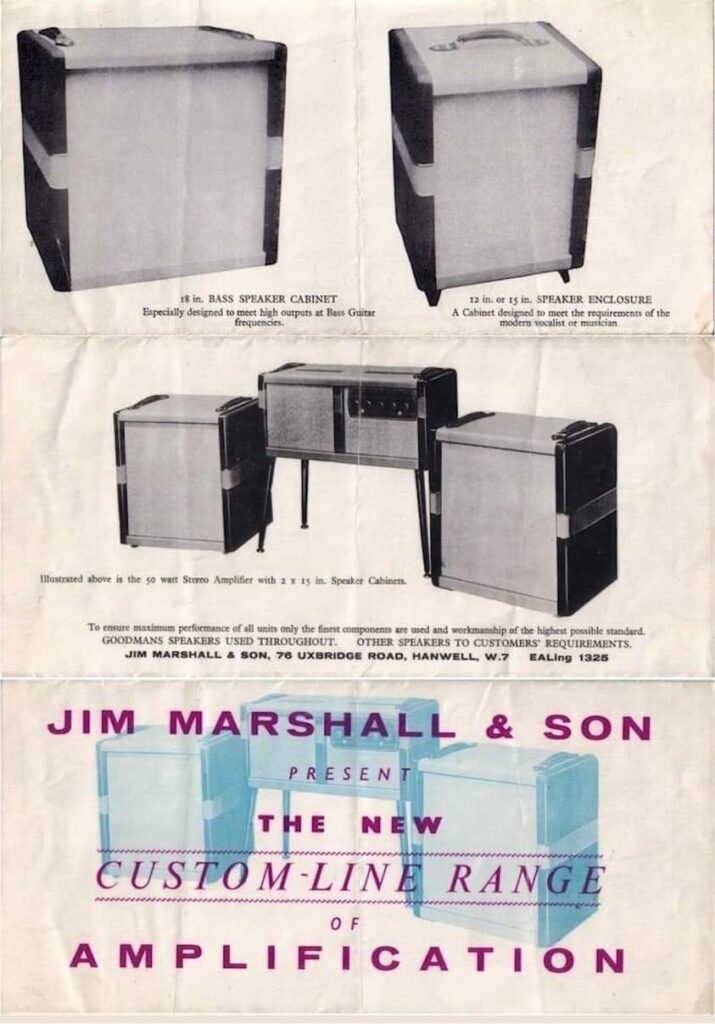
These cabinets are among the earliest known Marshall PA designs, built either in the backroom of Jim’s Hanwell drum shop by trusted craftsman John Fleerakkers, or possibly even at Jim’s home workshop — during a period when he was selling the “Custom Line Range” of PA equipment directly to trusted local clients.
Jim Marshall, long before becoming a household name in amplification, was a gigging musician and PA man. He was known for “modifying PA monitors” and “knowing what he liked in a speaker cabinet,” as quoted in later interviews. His preferred format during these years was the vertical 2×12 column. These cabinets are prime examples of that personal design ethos. Measuring 12″ deep at the base and tapering to 9″ at the top, just like the first 4×12 cabinets. These predate and arguably helped inspire the later 4×12 format Marshall would become famous for.

Early Marshall cabinets all had a unique way that the smooth tolex covered the corners, and these have that exact uniqueness to the front corners.

Prototype Columns – tolex covering style and early gold piping.
The grill cloth is the exact same cloth that Jim used for the mail-order only ‘Marshall Capri’ which is well documented to have been made in limited numbers to ‘use up leftover parts’. The cloth on the Capri’s is likely to have been hanging around from the custom line range days making these cabinets.
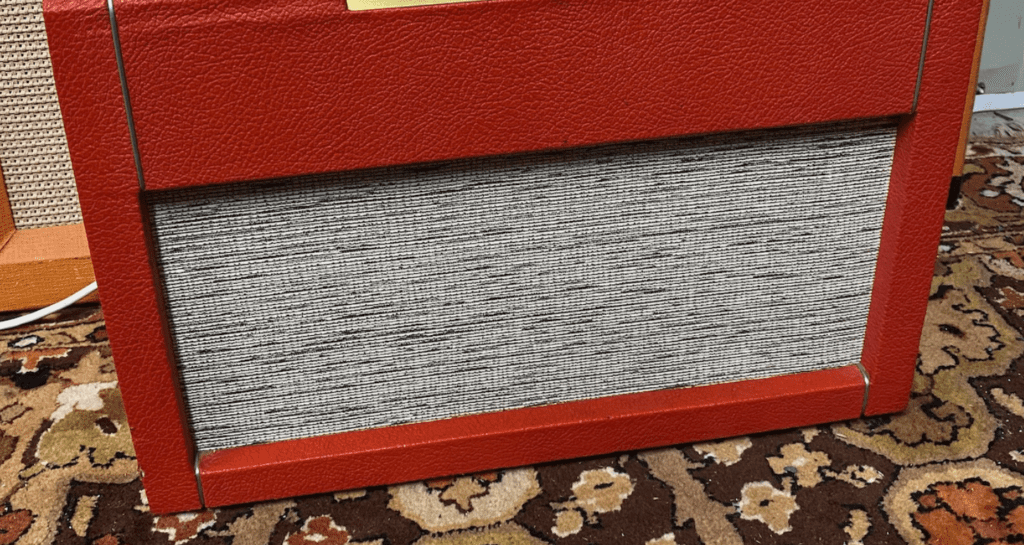
Notice the same cloth as used in the later Marshall Capri ‘Mail-Order’ amplifiers!
They also come with original grey vinyl covers, as seen on the early Marshall production-line columns.

Build Quality
These units have all the hallmarks of hand-built, pre-factory prototypes: crude yet functional joinery, and none of the branding Marshall would later adopt — just a pair of custom ‘Mike St. John’ badges affixed where Jim would have typically left the cabinet blank unless promotional value dictated otherwise. Beneath these are no additional logo mounting holes, confirming they were never intended to wear a Marshall logo (see the earliest picture of Eden Kane with a pair of ‘Marshall’ columns).

The speaker history of these cabinets tells a story all of its own. As Jim himself recalled of the early cabinets: “we kept blowing speakers like there was no tomorrow.”. These certainly saw their share of trials. The original baffle holes align only with Wharfedale units, and not with Celestion or Goodmans. This confirms these cabinets were fitted with Wharfedales from day one. In the early flyers distributed, Jim offered ‘other speakers to customers’ requirements’.

That’s a rare find in itself, and likely a choice made by Mike St. John himself — a Midlands-based DJ, not a traditional musician, which explains the sonic preference.

Even the jack sockets tell the tale.Aadditional rear jacks suggest each speaker was independently wired at some point. Again a rare setup indicative of DJ use or bespoke client request.

Speakers
When found, the cabinets housed a mismatched set of drivers. A pair of 1965 dated Wharfedale’s and a pair of 1970s Fane POP speakers. The latter pair were retrofitted with new mounting holes drilled in the baffle. The original Wharfedale’s were long gone – likely to be a nice set of often-used Wharfedale Alnico’s dating to 1961/1962.

It’s suspected that Mike St. John took these cabinets in for a speaker refresh around May 1965, receiving a full set of the latest model Wharfedale’s to replace the originals. Two of those May 1965 dated speakers then blew sometime in the ’70s and were replaced with the Fanes.

To bring them back to period-correct spec, I found a pair of 1962 Wharfedale speakers. These are correct in make and era, although not the originals – to replace the 1970s Fane POPs. Ideally, I would think finding a quad of original’s would suit. They would be Wharfedale Alnico’s from 1961/1962. I will keep a lookout!

However, I would bear in mind that these cabinets are really about the history, not the high-end sound. They’re not really suited as a playing pair today. I am selling this for their historical value, not the incredible sound. The Wharfedale speakers are pretty rough by modern standards. Don’t expect great tone — their value is in the story they tell, not the sound they make.
These cabinets are a snapshot of early Marshall PA life — authentic, hand-built, pre-Marshall pieces that show where it all started.
Early “pre” Marshall gear rarely surfaces, and almost never in pairs — let alone examples with this much provenance and character. These are the missing link between Jim’s PA days and the birth of the Marshall 4×12. For historians, collectors, or anyone seeking the DNA of British amplification, this is a one-off opportunity.
